In acute care settings such as the Neonatal Intensive Care Unit (NICU) or Stroke Units, time is the most critical resource. Traditional genetic testing, which often requires samples to be transported to a central laboratory, typically takes days or weeks to return results—far too long to influence immediate emergency treatment decisions.
Genedrive® bridges this gap by delivering molecular diagnostic accuracy directly at the bedside. This platform offers a decentralized, “Sample-to-Answer” solution that empowers clinicians to make life-altering personalized medication decisions within the “Golden Hour” of patient admission.
The Genedrive® System: Designed for the Point of Care
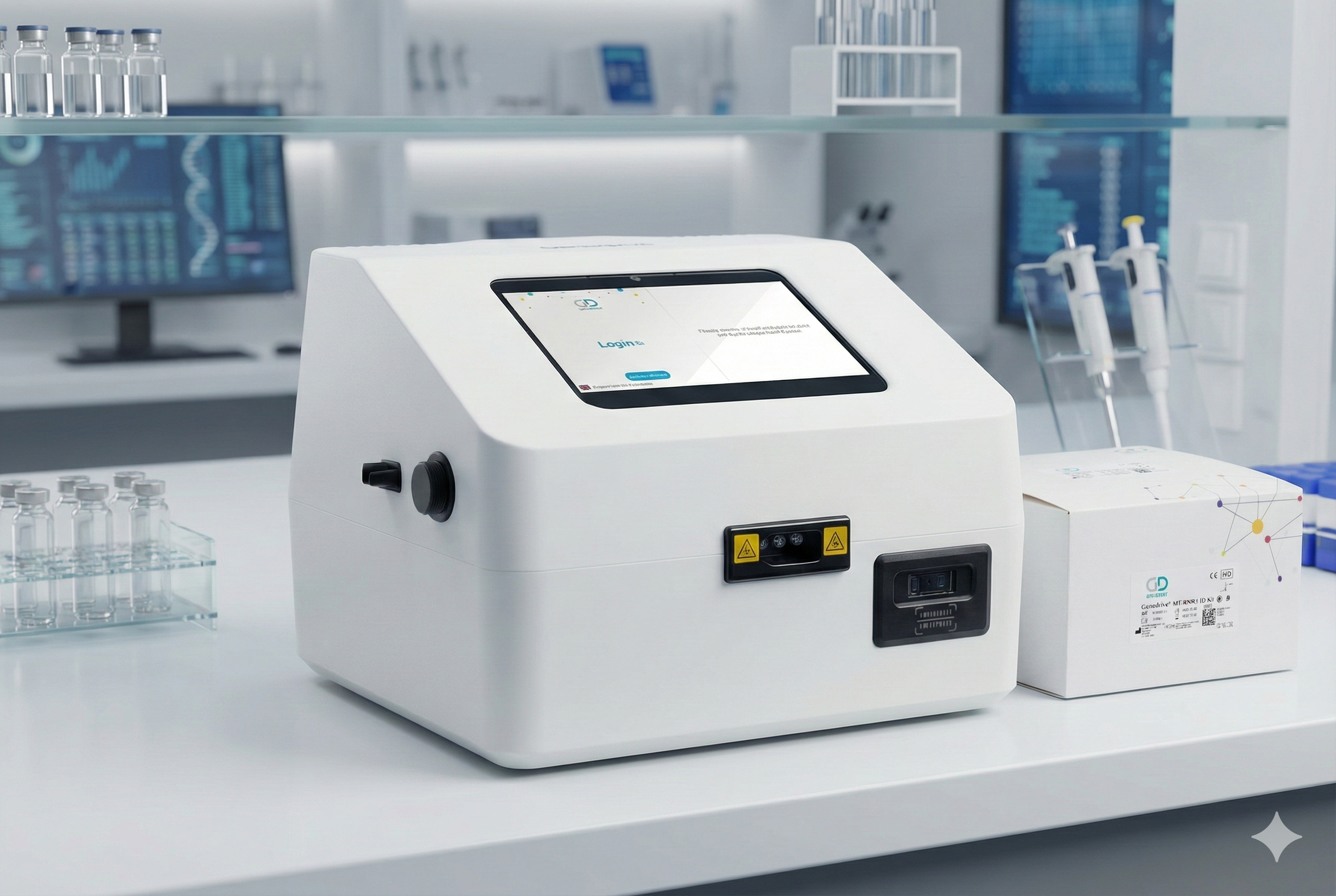
The core of the solution is the Genedrive® System, a compact, automated benchtop device designed specifically for non-laboratory healthcare professionals. Unlike complex laboratory equipment, it features a simple user interface and robust hardware suitable for busy clinical environments.
Key Technological Advantages:
- No Cold Chain Required: A major logistical breakthrough is the use of lyophilised (freeze-dried) reagents. Both the MT-RNR1 and CYP2C19 kits are stable at room temperature, eliminating the cost and complexity of cold-chain transport and storage.
- Rapid Turnaround: The system delivers results in clinically relevant timeframes (approx. 26 minutes for MT-RNR1 and 69 minutes for CYP2C19), allowing for immediate prescribing decisions.
- Ease of Use: The workflow is simplified into three steps: Swab (buccal), Mix, and Insert Cartridge. The system utilizes RFID technology to automatically recognize the kit type and expiry date, preventing the use of expired reagents.
- Maintenance Free: The system is designed to be maintenance-free with no user-serviceable parts, reducing operational downtime.
Clinical Application 1: Neonatal Deafness Prevention (MT-RNR1)
The Genedrive® MT-RNR1 ID Kit is the world’s first point-of-care genetic test used to guide neonatal management in time-critical settings.
- The Challenge: Approximately 1 in 500 babies carries the m.1555A>G mutation in the MT-RNR1 gene. If these infants are treated with aminoglycoside antibiotics (like gentamicin) for sepsis, they can suffer permanent, profound hearing loss (ototoxicity) after just a single dose.
- The Solution: The Genedrive test screens for this specific genetic variant using a non-invasive buccal swab.
- Impact: Delivering a qualitative result in roughly 26 minutes, the test allows neonatologists to identify at-risk babies before administering antibiotics. If the variant is detected, alternative antibiotics can be prescribed, saving the child’s hearing. This innovation has been recommended by NICE (National Institute for Health and Care Excellence) and creates significant cost savings by avoiding lifetime costs associated with cochlear implants.
Clinical Application 2: Stroke Management (CYP2C19)
The Genedrive® CYP2C19 ID Kit enables personalized antiplatelet treatment for stroke and Transient Ischemic Attack (TIA) patients.
- The Challenge: Clopidogrel is a standard treatment for preventing secondary strokes. However, the CYP2C19 liver enzyme is required to metabolize Clopidogrel into its active form. Patients with “Loss of Function” (LoF) genetic variants metabolize the drug poorly, leaving them unprotected against future strokes.
- The Solution: This molecular test identifies six clinically relevant alleles (*2, *3, *4, *8, *17, *35), distinguishing them from the wild type (*1). It categorizes the patient’s metabolizer status (e.g., Poor, Intermediate, Normal, or Ultra-Rapid).
- Superior Accuracy: In a clinical study comparing Genedrive against a widely used laboratory panel (Agena Veridose), Genedrive demonstrated 100% sensitivity and specificity. Notably, Genedrive correctly identified variants (specifically the *35 allele) that the central lab method failed to detect.
- Workflow Integration: With a run time of roughly 69 minutes, clinicians can determine the correct antiplatelet therapy (Clopidogrel vs. Ticagrelor/Prasugrel) before the patient leaves the acute care setting.
Data Connectivity and Quality Control
To meet the rigorous demands of modern healthcare IT infrastructure, the Genedrive system supports seamless integration:
- Middleware Compatibility: Results can be automatically uploaded to the patient’s Electronic Health Record (EHR) via Ethernet or Wi-Fi, reducing manual transcription errors.
- Quality Control: The system includes internal process controls (IPC) within every cartridge to verify assay performance. Additionally, external Control Kits (Positive and Negative controls) are available for routine quality assurance monitoring.
Conclusion
The Genedrive® POCT solution represents a paradigm shift in pharmacogenetics. By moving molecular diagnostics from the central lab to the bedside, hospitals can ensure that critical therapeutic decisions—whether protecting a newborn’s hearing or preventing a secondary stroke—are personalized, timely, and based on the highest standards of genetic accuracy.